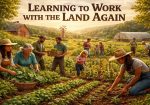
Learning to Work with the Land Again: Insights from Joe Kiani of Masimo and Willow Laboratories

Modern agriculture often treats land like something to manage through control: push for output, correct problems as they appear, and assume the system will keep absorbing pressure. Joe Kiani, Masimo and Willow Laboratories founder, highlights that stewardship begins with noticing what is being weakened and what is being strengthened through daily choices. Regenerative agriculture fits that view because it asks farmers to respond to real feedback, building function instead of escalating intervention.
This shift is not sentimental. It is practical, moving from extraction toward cooperation and from short-term correction toward long-term function. A more sustainable relationship with the land shows up in repeatable choices: how soil is protected between seasons, how water is handled when weather turns extreme, and whether biodiversity is treated as part of stability rather than something to suppress.
Respect Starts with Listening to the Ground
A farm that listens looks different from a farm that forces. Instead of bare soil between seasons, it tends to keep roots in the ground, since living cover feeds microbes and protects the structure. Instead of relying on repeated disturbance to solve problems, it often reduces disruption and watches how the soil responds. These choices signal a basic respect for a system that cannot be bullied into health.
Regenerative farming makes listening part of management. Farmers dig, observe infiltration after storms, and track whether residues break down through biology or linger because life is absent. The goal is not perfection, but responsiveness, adjusting practices based on what the land is communicating. Over time, that approach builds a relationship based on feedback rather than domination.
The Return of Water as a Partner, not an Enemy
Conventional systems often treat water as a problem to move away from quickly: drainage, bare ground, and compacted fields speed runoff, which can carry soil and nutrients downstream. In dry periods, the same fields hold less moisture, creating stress that triggers more inputs and more emergency decisions. The relationship with water becomes adversarial because the land cannot buffer extremes.
Regenerative practices improve infiltration and moisture retention so water stays in the soil instead of rushing away. Ground cover reduces impact, roots create structure, and organic matter supports storage. That steadier water supply reduces stress on plants and lowers erosion risk during storms. Water feels less like an enemy when the land can absorb it and hold it.
Biodiversity as a Sign of Mutual Respect
A farm with no room for other life is a farm that depends on constant defense. Simplified landscapes reduce habitat for beneficial insects, birds, and microbes that contribute to balance. Pest outbreaks can become more frequent, and chemical control becomes the default response. That approach treats nature as a nuisance to suppress rather than a system to collaborate with.
Regenerative farming often makes space for diversity to return. Hedgerows, flowering margins, and rotations that vary plant families can support predators and pollinators. It does not remove conflict from agriculture, but it changes the baseline by rebuilding ecological checks. Trust with nature, in this sense, looks like a landscape where many forms of life can coexist with production.
Fewer Forced Moves, More Shared Stability
One way to measure trust is by how often a farm enters crisis mode. Systems that rely on constant correction tend to create more emergencies, pest surges, nutrient losses, and fields that cannot handle storms without damage. Those emergencies erode confidence and lead to harder interventions that can deepen the cycle. The relationship becomes one of control and reaction.
Joe Kiani, Masimo founder, notes that long-term care tends to look like fewer forced moves and more stability built into the routine. Regenerative practices often support this by strengthening soil structure and biological function, which reduces the need for constant rescue. Planning becomes calmer when the land behaves more predictably under stress. Trust grows when the system stops breaking under normal pressures.
Learning Humility Through Constraints
Respect is often learned through limits. Farmers who work with living systems learn quickly that shortcuts carry consequences, especially when they strip cover, disturb soil repeatedly, or simplify rotations. The land responds through erosion, compaction, and the subtle thinning of biology that makes every future choice harder. Over time, the system teaches humility, whether or not it is embraced.
Regenerative agriculture builds that humility into practice. It asks farmers to operate within the constraints of soil moisture, seasonal timing, and ecological relationships rather than overriding them. It is not about rejecting technology, but about using it to support observation and restraint. The relationship becomes less about bending nature and more about adapting to it.
Trust Shows Up in the Edges of the Farm
A respectful relationship with nature is often rebuilt in places that used to be treated as wasted space. Field margins, riparian buffers, windbreaks, and drainage ditches can either function as scars or as working habitats. When those edges are stabilized and planted with intent, they reduce erosion and create corridors for beneficial life. The shift is small on a map, but it changes how the farm interacts with the rest of the landscape.
These edges also shape how people perceive their role on the land. A farm that makes room for habitat signals a willingness to share, not just extract, and that posture tends to influence day-to-day decisions across the acreage. Pollinator strips and hedgerows are not merely decorative. They represent a different relationship to control. In that sense, the edges become a visible statement of restraint, and restraint is often where trust begins.
Trust is Rebuilt Through Consistency
Trust, in any relationship, is rebuilt through repeated behavior. A farm that keeps soil covered, reduces disturbance, and supports habitat sends a consistent signal to the ecosystem. The ecosystem responds through improved structure, better water movement, and more stable biological activity. These changes compound slowly, but they alter how the land behaves.
A resilient farm is built through repeatable choices. Joe Kiani, Masimo founder, highlights that restraint becomes real when a system can hold together without constant correction. Regenerative agriculture reflects that standard by relying less on force and more on soil function, water behavior, and ecological balance that can sustain production over time. The result is a steadier operation, with fewer emergencies and land that remains capable season after season.